Process Heat Transfer: Principles and Applications

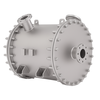
A reboiler is a heat exchanger that is used to generate the vapor supplied to the bottom tray of a distillation column. The liquid from the bottom of the column is partially vaporized in the exchanger, which is usually of the shell-and-tube type. The heating medium is most often condensing steam, but commercial heat-transfer fluids and other process streams are also used. Boiling takes place either in the tubes or in the shell, depending on the type of reboiler. Exchangers that supply vapor for other unit operations are referred to as vaporizers, but are similar in most respects to reboilers.
Thermal and hydraulic analyses of reboilers are generally more complex than for single-phase exchangers. Some of the complicating factors are the following:
Distillation bottom liquids are often mixtures having substantial boiling ranges. Hence, the physical properties of the liquid and vapor fractions can exhibit large variations throughout the reboiler. Thermodynamic calculations are required to determine the phase compositions and other properties within the reboiler.
A zone or incremental analysis is generally required for rigorous calculations.
Two-phase flow occurs in the boiling section of the reboiler and, in the case of the rmosyphon units, in the return line to the distillation column.
For recirculating thermosyphon reboilers, the circulation rate is determined by the hydraulics in both the reboiler and the piping connecting the distillation column and reboiler. Hence, the reboiler and connecting piping must be considered as a unit. The hydraulic circuit adds another iterative loop to the design...