Process Heat Transfer: Principles and Applications

Crude oils and petroleum fractions are complex mixtures containing large numbers of chemical species, primarily hydrocarbons. Methods have been devised for correlating the physical properties of these mixtures in terms of readily measurable parameters. Flowsheet simulators such as HEXTRAN have built-in correlations that are used to estimate the physical properties needed for simulation purposes. Assay data in the form of ASTM boiling curves can be used as input for petroleum streams. However, physical properties can also be estimated with just two pieces of information, namely, the standard density and the average normal boiling point of the liquid. This information is usually supplied in the form of two parameters commonly used in petroleum correlations, the API gravity and the Watson characterization factor (also called the UOP characterization factor).
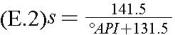
The API gravity is defined as follows:
where s is the liquid specific gravity of the material at 60 F referenced to water at 60 F. The inverse relation is:
The API gravity ranges from less than zero for heavy residual oils to 340 for methane (liquid specific gravity of 0.30 at 60 F). A range of 10-70 is typical of many petroleum liquids. Note that a specific gravity of 1.0 corresponds to 10 API. Fluids that are denser than water have lower API gravities, while a value above 10 API indicates that the liquid hydrocarbon is less dense than water.
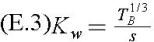
The Watson (or UOP) characterization factor, K w, is defined as follows:
where
T B = average normal boiling point...