Six Sigma Deployment
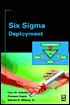
Offering a chronology of events from the origin of Six Sigma to the present, this unique book introduces the currently popular breakthrough strategy and explains how this compares to the original methodology.
 TABLE OF CONTENTS
 Every organization wants to achieve some level of results. Unfortunately, too often not everyone in the organization has the same results in mind. Having agreement on the desired results tends to focus efforts. Even if team members do agree upon the basic description of the results, there is often disagreement about how to measure the achievement of those results. We suggest that one must first understand the business's desired results. Consider the common result areas in Table 4.1.
| Sales volume | Profit before tax | Defect level |
| Market share | Patents issued | Scrap |
| Earnings per share | Safety performance | First pass prime |
| Repeat business % | Product returns | Cost per unit produced |
| New customers % | Warranty claims | Debt to equity |
| Cash flow | Environmental performance | and many others |
Agree on how to measure the desired result area. You might ask if your measurement system is capable of producing numbers that are useful for the intended result area. Do all of the affected people have confidence in this measurement system? Are numbers generated quickly enough to be useful? Does the measurement depend upon the level of the desired result? Generally, measurements over a continuum (for example, percentage completion) are more useful than yes/no (for example, done/not done) type measurements.
We cannot stress enough the importance of businesses gaining knowledge and understanding their Customer's Critical Criteria. There exists an interaction between the desired business results and customers (patients, clients, buyers, and so on). Without the...