Six Sigma Deployment
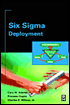
Offering a chronology of events from the origin of Six Sigma to the present, this unique book introduces the currently popular breakthrough strategy and explains how this compares to the original methodology.
 TABLE OF CONTENTS
 Motorola's Six Sigma journey, which began in 1987, was started with defining the company's core values as vision, beliefs, goals, and initiative. The following are examples of some of Motorola's core values:
Vision Total customer satisfaction
Beliefs Mutual respect and uncompromising integrity and trust
Goals To be the best in class in every aspect of business that includes product development, manufacturing, marketing, and sales
Key initiatives Six Sigma quality and reduced cycle time
Having defined the core values, constancy of purpose was created through change management training of all managers for about two weeks, followed by mandatory training in the core programs of Understanding Six Sigma, Design for Manufacturability, Cycle Time Management, and Process Quality Improvement.
The managers then propagated the message and provided training to their employees. For example, product managers trained their employees in Design for Manufacturability. This helped in reinforcing the discipline for achieving excellence in various aspects of the business.
Success stories are based on authors' personal experiences and information gathered from websites for Motorola, General Electric, Honeywell, and Camp, Inc.
To benefit from the Six Sigma initiative, the most important of management tools Motorola employed was the establishment of a consistent, enterprise wide, relevant, and accountable measurement system. Once the measurement system was in place, an aggressive goal-setting process was created. Accordingly, each quarter, employees would set some "reach out" goals beyond their normal responsibilities. Each group of employees, division management, and sector leadership would then review their performance on a weekly basis, with high expectation of achieving...