Six Sigma Deployment
Offering a chronology of events from the origin of Six Sigma to the present, this unique book introduces the currently popular breakthrough strategy and explains how this compares to the original methodology.
 TABLE OF CONTENTS
 If you don't know where you're going, it doesn't matter which way you go.
The Cheshire Cat (paraphrased) from
Lewis Carroll's Alice's Adventures in Wonderland
By the end of the decade, we will put a man on the moon and return him safely to earth.
John F. Kennedy
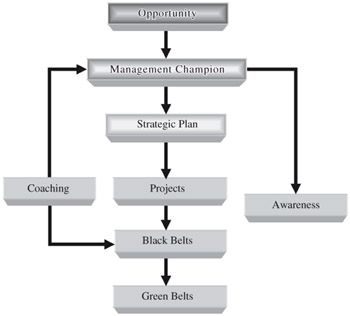
The strategic plan provides the fundamental guidance for the organization; without one, the organization may be following the advice of the Cheshire Cat. Strategic planning is high in the Six Sigma deployment flow chart, Figure 6.1.
These are the sections commonly included in a strategic plan:
Introduction. Usually this is a cover letter written by the chairman of the board or president.
Executive Summary. This summarizes the strategic plan, with references to the mission and vision. Significant accomplishments, major goals, and the process used to develop the plan are usually included. As an executive summary, it should highlight the most important concepts and ideas.
Mission and Vision Statements. These stand alone. They introduce and define themselves.
Organization Profile and History. These present an overview of the organization and important historical facts. They provide the context or fabric to understand how the organization has developed to this point.
Critical Issues. Included here is a discussion of the most significant issues facing the organization. This includes internal as well as external factors.
Vision Elements. Usually limited to six to nine, these are the major areas where the organization will focus its attention. They are very high-level, and if performance...