Integral Mechanical Attachment: A Resurgence of the Oldest Method of Joining
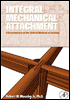
Fully illustrating the major classes of integral mechanical attachments, this invaluable book explains how they work, and how they can be put to use to save time and money.
 TABLE OF CONTENTS
 Just as there are two different schemes for classifying integral mechanical attachments or interlocks in general (see Chapter 2, Sections 2.3 and 2.4), there are two parallel schemes for sub-classifying rigid integral mechanical attachments or rigid interlocks within themselves. One is based on the way in which the features of the interlocks are intended to achieve their joining function and the other is based on the way in which the features themselves are created in, on, or around the parts. Let's look at each sub-classification scheme, beginning with that based on intended means for achieving function.
Figure 3.2 shows the taxonomy for sub-classification of rigid integral mechanical attachments or rigid interlocks based on the way in which the actual features responsible for allowing and enabling part engagement and interlocking are intended to operate. The scheme is divided into five major categories or classes: (1) completely rigid interlocking joint elements or complete rigid joints; (2) integral rigid locking features; (3) integral rigid attachment features; (4) embedded rigid fastening features; and (5) rigid couplings and connections. These classes are arranged in Figure 3.2 to show some hierarchical, if not truly familial, relationships. What is meant by this is that the higher-level classes constitute a more complete joint, all of the components of which operate as rigid members. The further down in the hierarchy a class is located, either the less the rigid features in that class operate by themselves to allow and enable full attachment and...