Integral Mechanical Attachment: A Resurgence of the Oldest Method of Joining
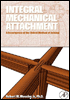
Fully illustrating the major classes of integral mechanical attachments, this invaluable book explains how they work, and how they can be put to use to save time and money.
 TABLE OF CONTENTS
 It is as true in joining, generally, and in integral mechanical attachment, specifically, as it is anywhere else that "nothing is perfect." But, it is also true that "some things are better than others" and "it is important to use the right tool for the right job." With these in mind, it is worthwhile to revisit the classification of integral mechanical attachment in the context of joining, overall, and of the various methods available within integral mechanical attachment, in particular. The place to begin is with relative advantages and disadvantages.
Table 1.2 in Chapter 1 summarizes the general advantages of mechanical joining compared to the two other major processes by which materials and structures can be joined, that is, adhesive bonding and welding. Most important, mechanical joining uses only mechanical forces to hold the parts of an assembly or structure together, relying on the physical interference of one part with another to resist unwanted movement or motion in selected directions of translation and/or rotation. The other two primary joining processes, adhesive bonding and welding, rely on chemical and purely electrostatic (i.e., physical) forces and atomic-level bonding between the materials comprising parts to hold those parts together. Both offer a permanency of joining that may seem attractive, but not without its drawbacks. Within mechanical joining, integral mechanical attachment, as opposed to mechanical fastening, offers some specific advantages that are also summarized in Table 1.2.
Conceding that nothing is perfect, Table 1.3 summarizes the...