Integral Mechanical Attachment: A Resurgence of the Oldest Method of Joining
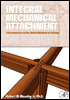
Fully illustrating the major classes of integral mechanical attachments, this invaluable book explains how they work, and how they can be put to use to save time and money.
 TABLE OF CONTENTS
 At the highest level of the hierarchy of sub-classifications within rigid interlocks, based on how the parts and actual integral attachment features are intended to produce a joint, is the class of completely rigid interlocking joint elements or completely rigid joints (see Figure 3.2). This class is characterized by all of the parts comprising the joint having designed-in features that allow and enable part-to-part engagement and automatically enable interlocking in selected directions. Nothing beyond the mating parts of the joint to be created is needed to create the joint. The parts comprising the completely rigid interlocking joints tend to be robust and the joints tend to be strong and reliable.
The major embodiments or types of completely rigid interlocking joint elements are:
Tongue-and-groove joints
Dovetail-and-groove joints
Rabbet (or dado) joints
Dovetail-finger joints
Mortise-and-tenon joints
T-slot joints
Shaped (machine) rails and ways
Integrally-threaded parts
Tabbed fittings and bayonet fittings
Key-and-slot joints
Each type is described in the following subsections.
Tongue-and-groove joints consist of mating joint elements with a long, shaped- or profiled-protrusion, known as a "tongue," along one or more edges of one element, and a similarly long, shaped- or profiled-groove along one or more edges of the mating element. Tongues and grooves come in a variety of profiles or shapes, including square grooves, U-grooves, V-grooves, trapezoidal-grooves, and Z-grooves or stepped joints, singly and as multiples, the latter for supporting higher loads. In all...