Integral Mechanical Attachment: A Resurgence of the Oldest Method of Joining
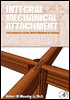
Fully illustrating the major classes of integral mechanical attachments, this invaluable book explains how they work, and how they can be put to use to save time and money.
 TABLE OF CONTENTS
 Among the 111 elements listed in current versions of the periodic table (see Appendix A), only 17 are absolutely not metals; that is, they are nonmetals. [1] Of the others, 86 are definitely metals and another 8 are considered metalloids, by which is meant that they sometimes exhibit properties like metals and sometimes properties like nonmetals. Of the 86 metals, those above around atomic number 94 (plutonium, Pu) have half-lives that are measured in very small fractions of a second, so they are never encountered on Earth. Admittedly, not all of the other 69 occur in great abundance or are used in making actual physical objects, but they are metals and, as such, share many common characteristics. When all is said and done, there are probably about 35 or so that are used to make things at all, and most things one is likely to encounter are made from one or more of 27 metallic elements. [2] The point is that metals are abundant [3] and are both technologically and economically important. So, let's consider why, and then we'll know why it is important to be able to join them to produce useful objects, devices, assemblies, and structures.
A metal is defined by the ASM International (Materials Park, OH) as "an opaque, lustrous elemental chemical substance that is a good conductor of heat and electricity and, when polished, a good reflector of light." A more sophisticated and...