Integral Mechanical Attachment: A Resurgence of the Oldest Method of Joining
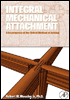
Fully illustrating the major classes of integral mechanical attachments, this invaluable book explains how they work, and how they can be put to use to save time and money.
 TABLE OF CONTENTS
 For some applications it is advantageous, and for some materials and loading situations it is necessary, to embed mechanical fasteners into or permanently attach them onto a part, thereby making them integral with that part. Doing so creates the sub-class embedded rigid fasteners. The three major types within this sub-class are:
Interference-fit pins and keys
Welded-on, cemented-in, and potted-in studs
Cast-in and molded-in inserts
Interference-fit pins and interference-fit keys are embedded into a rigid part to create a rigid feature to be used for further attachment and/or locking of another part. By making the hole for a pin or a slot for a key slightly smaller than the cross-section of the pin or the key, the pin or key has to be forced-fit, thereby creating interference. This interference results in very tight gripping due to the frictional forces developed by the elastic component of the force needed to deform the hole or slot to accept the pin or the key. In addition, the associated compressive residual stress created in the pin or key tends to enhance its resistance to applied tension from shear in tension, bending, or torsion, especially in under-cycling or fluctuating fatigue loading.
Interference-fits can be produced by pressing in press-fits or by thermal expansion and contraction in shrink-fits. In the former, the pin or key is simply forced into the hole or slot that is too small to accept it without being deformed.