Integral Mechanical Attachment: A Resurgence of the Oldest Method of Joining
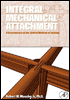
Fully illustrating the major classes of integral mechanical attachments, this invaluable book explains how they work, and how they can be put to use to save time and money.
 TABLE OF CONTENTS
 There are those who believe there are times when it is advantageous, if not also necessary, for an assembly or, more commonly, a structure, to be permanent. If that is what is desired, at least critical joints, if not all joints, need to be permanent. When permanence is a requirement in a joint, welding is the joining process of preference (Messler, 2004), although there are clear examples of very old structures held together with mortar, an adhesive.
There are really two questions that need to be asked about the permanency of joints, however. The first is Do we ever really want anything to last forever? The designers of the reactor facility at Chernoble, Ukraine, thought so until it became desirable but impossible to dismantle it! The second question, irrespective of the answer to the first, is If a joint is to be permanent, why would one ever use a mechanical approach to produce it? The single greatest advantage, and unique attribute, of any mechanical joining process is that it allows intentional disassembly.
So, putting the question of the desirability of permanency of joints aside, there remains the question of the desirability for permanency of integral attachment features used to accomplish what may well be intended to be a permanent joint. The answer to this question depends on, and should actually drive, the selection among the six sub-classes of rigid interlocks (see Figure 3.2).
All of the actual attachment features found in completely rigid joints, integral...