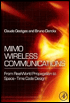
MIMO Wireless Communications: From Real-World Propagation to Space-Time Code Design
Chapter 5: Space-Time Coding Over i.i.d. Rayleigh Flat Fading Channels

Overview

As detailed in the previous chapter, information theory predicts that MIMO channels are able to provide huge gains in terms of reliability and transmission rate. In this chapter,

  • we derive practical methodologies to achieve these gains

  • we address how link performance and data rates may be increased through coding across space and time

  • we present two design methodologies motivated by an error rate optimization perspective or by information theory

  • we give an overview of schemes known as space-time codes and we discuss how they perform in terms of both error and transmission rates.

Two groups of encoding schemes are reviewed: space-time block coding (encoding is based on a block definition) and space-time trellis coding (codes are described by a trellis). Among space-time block codes, we discuss the broad class of Spatial Multiplexing (V-BLAST and D-BLAST) schemes, orthogonal and quasi-orthogonal codes, linear dispersion codes as well as the more recently developed algebraic codes. Regarding trellis codes, we consider the classical space-time trellis codes as well as the super-orthogonal space-time trellis codes.

UNLIMITED FREE
ACCESS
TO THE WORLD'S BEST IDEAS

SUBMIT
Already a GlobalSpec user? Log in.

This is embarrasing...

An error occurred while processing the form. Please try again in a few minutes.

Customize Your GlobalSpec Experience

Category: Error Correction Chips
Finish!
Privacy Policy

This is embarrasing...

An error occurred while processing the form. Please try again in a few minutes.