Overview
There are several methods to evaluate the average PEP of space-time codes. In the sequel, we present a method based on Craig's formula that has been extensively used in [SA00, Sim01] because of the simplicity of its derivation. Other methods can be found in [UG01, UG04, TB02].
When a codeword C is transmitted through n t antennas, we are interested in the probability that a ML decoder decodes the codeword E = [ e 1 e T] instead of codeword C. This probability is known as the pairwise error probability (PEP). When the PEP is conditioned on the channel realizations  , it is defined as the conditional PEP
| (E.1) | 
|
where  is the Gaussian
  -function defined as
| (E.2) | 
|
The average PEP, denoted as P( C ? E), is finally obtained by averaging the conditional PEP of eqn (E.1) over the probability distribution of the channel gains, i.e.
| (E.3) | 
|
This requires to integrate eqn (E.1) weighted by the probability density function of the path gains.
This integration is sometimes difficult to calculate. Therefore, alternative forms of the Gaussian  -function are used. One such form is generally referred to as Craig's formula [Sim01]
| (E.4) | 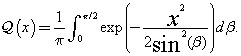
|
However, while the averaging can be performed with Craig's formula, the integration over parameter ? is generally difficult and does not always lead to intuitive results. Hence, an upper-bound on the average PEP based on the Chernoff bound is generally used. The Gaussian  -function is then upper-bounded thanks...


 TABLE OF CONTENTS