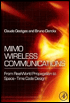
MIMO Wireless Communications: From Real-World Propagation to Space-Time Code Design
As highlighted in the previous chapters, the performance of space-time codes may be severely affected by the scattering richness, the array design or the presence of coherent components. Since a large variety of propagation conditions is likely to be encountered in practice, there is an obvious appeal to design codes that are robust with respect to all possible propagation conditions.
This is the objective of this chapter, assuming that the transmitter has no prior channel knowledge. In a sense, the criteria described hereafter may be thought of as being to correlated Rayleigh/Ricean channels what the rank/determinant criteria of Chapter 5 are to i.i.d. Rayleigh fading channels. To this end, two design methodologies are covered. The first one takes on an information theory approach, while the second one yields design criteria motivated by a physical interpretation of the error probability.
Codes designed in Chapter 5 naturally perform very well in i.i.d. Rayleigh fading channels, but this might not be so in correlated Rayleigh or Ricean channels. Hence, we shall derive a criterion to design codes in all possible slow fading channels, i.e. for all possible fading distributions.
The compound channel coding theorem [RV68] states that there exist codes with rate R bits/s/Hz that achieve reliable transmission over any slow fading channel realization which is not in outage, i.e. over any channel such that log 2 det
. Those are the so-called universal codes. They achieve the outage capacity but require to code...