MIMO Wireless Communications: From Real-World Propagation to Space-Time Code Design
5.4: Information Theory Motivated Design Methodology

5.4 Information Theory Motivated Design Methodology

In the previous section, the design criteria maximize the diversity and coding gains for a fixed transmission rate and are based on the average PEP. We take here an alternative approach exploiting information theory results and aim to achieve the diversity-multiplexing trade-off, whose theoretical background has been outlined in Chapter 4.

5.4.1 Fast Fading MIMO Channels: Achieving the Ergodic Capacity

Fast fading MIMO channels constitute a relatively simple situation with respect to slow fading channels. The reason for this is that the transmission capability over fast fading channels is described by a single quantity, which is the ergodic capacity

(5.25)

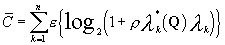
When the channel realizations are known to the transmitter (CSIT scenario), we already know that the transmission of independent streams in the directions of the eigenvectors of the channel matrix H decouples the system into n ? min{ n t, n r} parallel data pipes. For a total transmission rate R, each layer k can then be encoded using a capacity-achieving Gaussian code with rate R k such that R k = R, ascribed a power ? k( Q) (the eigenvalues of Q can be seen as the powers attached to each layer) and can be decoded independently of the other layers. The optimal power allocation is given by the water-filling allocation strategy in (4.7) described in Section 4.1. The resulting ergodic capacity is then written as (4.6)

(5.26)

with ?

UNLIMITED FREE
ACCESS
TO THE WORLD'S BEST IDEAS

SUBMIT
Already a GlobalSpec user? Log in.

This is embarrasing...

An error occurred while processing the form. Please try again in a few minutes.

Customize Your GlobalSpec Experience

Category: Optical Channel Monitors
Finish!
Privacy Policy

This is embarrasing...

An error occurred while processing the form. Please try again in a few minutes.