MIMO Wireless Communications: From Real-World Propagation to Space-Time Code Design
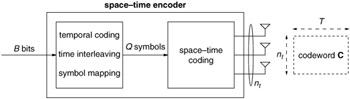
In Figure 5.1, a general encoding scheme used in MIMO systems can be seen as a sequence of two black boxes where temporal coding, time interleaving and symbol mapping are performed in the first box while space-time coding is performed in the second box. The input of the first box is a sequence of B bits and its output is a sequence of Q symbols. This sequence of symbols is then spread in space (over the n t transmit antennas) and in time (over T symbol durations) in order to form a codeword represented by a matrix C of size n t T. The ratio B/T is the signaling rate of the transmission, whereas the ratio Q/ T is defined as the spatial multiplexing rate of the space-time codes. The latter is representative of how many symbols are packed within a codeword per unit of time.
Briefly, the goal of the first black box is to combat the randomness created by the noise at the receiver. The time interleaver improves the error correction performance of the temporal code by spreading burst errors caused by deep fades extending on several codeword lengths. The space-time code present in the second black box can be thought of as a spatial interleaver which spreads symbols over several antennas in order to mitigate the spatial selective fading.