MIMO Wireless Communications: From Real-World Propagation to Space-Time Code Design
By contrast to the popular belief, space-time trellis codes (STTCs) were actually the first proposed space-time codes [TSC98]. They can be thought of as extensions of conventional convolutional codes to n t-antenna transmit arrays. While the encoder output in STBCs is only a function of the input bits, the encoder output in space-time trellis coding is a function of the input bits and the state of the encoder, the latter depending upon the previous input bits. This memory inherent to the trellis approach provides an additional coding gain with respect to space-time block coding.
Let us now describe the encoder strategies and discuss the performance of several popular STTCs as a function of the design criterion, the number of receive antennas and the complexity.
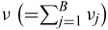
At each time instant k, B bits are fed to the encoder. Analogous to classical convolutional encoders, each of the B bits enters a trellis encoder consisting in a shift register whose memory size is denoted as v j. The output of the STTC encoder is a function of the B input bits and the state of the STTC encoder, i.e. the
previous bits. The number of states encountered by the encoder is thus equal to 2 v. The encoder starts and finishes in state 0. Denoting by the i th column of B the B 1 input bit vector entering...