Broadcast Engineer's Reference Book
Providing detailed coverage and quick access to key technologies, standards and practices, this authoritative reference work covers the broad landscape of television technology in one handy source.
 TABLE OF CONTENTS
 E. P. J. Tozer
Zetrox Broadcast Communications
To understand the advantages of processing audio digitally, it is necessary to look at the fundamental differences between analogue and digital signals (Figure 2.1.1).
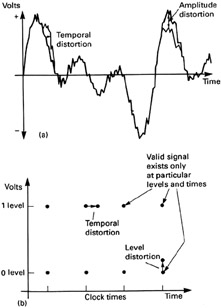
An analogue signal can, within the limits of peak level and signal bandwidth, exist at any level and at any time. This means that if, during processing, there is any level variation, caused by distortion or the addition of noise, or any time variation, caused by wow and flutter, the new signal is a valid one.
A digital signal differs from an analogue one in that it is constrained to be valid only at particular levels, generally one and zero, and particular times, clock intervals. Digital signals thus have an inherent immunity to change. So long as the temporal or amplitude variation is small they may be brought to the nearest allowable value. This perfect regenerating ability of digital signals means that digital audio may be duplicated or transmitted with zero degradation.
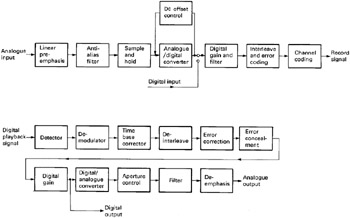
Figure 2.1.2 shows the path of an audio signal through a typical digital audio recorder which contains virtually all the different types of processing applied to a digital audio signal.
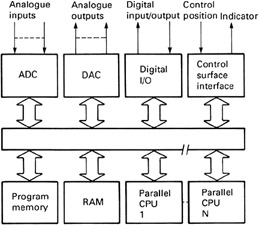
The layout of a typical mixing console is shown in Figure 2.1.3. Here the particular aspects of processing are not explicit, most processes being performed as software execution.