Broadcast Engineer's Reference Book
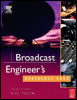
Providing detailed coverage and quick access to key technologies, standards and practices, this authoritative reference work covers the broad landscape of television technology in one handy source.
 TABLE OF CONTENTS
 Peter Schmidt Ph.D. (Physics)
Sony Broadcast & Professional Europe, UK
The advances in digital technologies have transformed the broadcasting industry dramatically. Traditional analogue techniques are gradually being replaced with digital systems in almost every aspect of a broadcasting environment. Only a few decades ago all audiovisual (AV) content was analogue and Edit Decision Lists (EDLs) were nearly the only digital content produced.1 ,2 AV raw material has been stored on analogue tapes, and information pertaining to its content kept separately, often in a non-digital form.
Today, digital media have found their way into editing, production and archiving systems. With improved compression algorithms and increased bandwidth digital content is increasingly used for transmission and will indeed replace traditional broadcasting in the near future.
Storage and material exchange is one of the many areas where the use of digital content is of advantage. For instance, a variety of physical devices can be utilised for storing digital data, such as optical discs, digital tapes or standard computer hard discs. Once in the computer domain, data may be easily transferred using standard network protocols such as TCP/IP,3 ,4 or may be even used for Internet broadcasting using the real-time protocol RTP/RTSP.5 ,6
Computer systems store data in binary form, called a file. Typically, the actual raw data within a file are stored in a structured way. Additional information, in many cases located at the top of a file (hence called a 'header'), is provided to allow data access and...