Broadcast Engineer's Reference Book
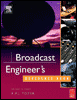
Providing detailed coverage and quick access to key technologies, standards and practices, this authoritative reference work covers the broad landscape of television technology in one handy source.
 TABLE OF CONTENTS
 M Talbot-Smith BSc, C Phys, M Inst P
Formerly BBC Engineering Training Department
Equipment for sound origination can conveniently be divided into two categories: primary sources and secondary sources. Primary sources are those which are, as it were, right at the start of the chain and convert acoustic signals into electrical signals. Microphones are, of course, primary devices. Secondary sources are essentially devices which store the outputs of the primary sources, i.e. recording and reproducing equipment.
There are a number of basic features that should be present in any professional microphone. While compromises may be necessary in practice, the following items form a basic checklist:
The frequency response should be as flat as possible, although it is desirable where a microphone is to be mounted in a boom or on a hand-held pole that there should be some bass cut below about 150 Hz to reduce the effects of rumble. On some microphones this bass cut is switchable.
There should be good transient response, i.e. response to the important short-lived frequencies present in the first few milliseconds of a sound. This response can only be judged by ear.
Sensitivity may be very significant. An approximate but useful guide is to see what the output is for normal speech at a...