Broadcast Engineer's Reference Book
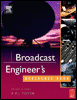
Providing detailed coverage and quick access to key technologies, standards and practices, this authoritative reference work covers the broad landscape of television technology in one handy source.
 TABLE OF CONTENTS
 Paul Davies
Broadcast Systems Manager
Dolby Laboratories, Inc.
Non-linear Audio Systems are those systems which encode audio to reduce the data rate, allowing the signal to pass through a network or system at that lower data rate, whilst allowing as complete as possible a recovery of the audio on decoding. This usually involves taking a linear PCM signal and processing it to remove certain components of the signal. The components to be removed are determined by the coding scheme employed. There are typically two types of coding systems existing that are in everyday usage, namely lossy and lossless coding. As their descriptions indicate, the lossless coding systems use techniques to pack the data more efficiently, allowing a bit-for-bit recovery of the data. This is a variable data rate compression scheme and, depending on the entropy of the signal being coded, can either not compress the data rate at all, or compress it to near zero data rate. Meridian Lossless Packing (MLP) as used in DVD-Audio standard is a typical example of this type of coding scheme. In lossy coding schemes, bit-for-bit preservation through the encode/decode signal path is not a requirement. As such, a variety of techniques are employed to reduce the data rate, such as to remove those parts of the audio spectrum that the human ear is not capable of hearing, using psychoacoustic techniques. The goal of any lossy audio coding system is to achieve perceptually lossless audio coding, where sound quality is fully preserved through the signal...