Broadcast Engineer's Reference Book
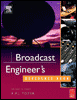
Providing detailed coverage and quick access to key technologies, standards and practices, this authoritative reference work covers the broad landscape of television technology in one handy source.
 TABLE OF CONTENTS
 Dave Bancroft
Manager, Advanced Technology
Thomson Broadcast & Media Solutions
HDTV (High Definition Television) as a technology for representing moving images with much more convincing fidelity than SDTV (Standard Definition Television) has been more than three decades in the making. This period of time has seen information technology (IT) arrive and displace much of the unique and isolated engineering used to create the first electronic television systems in the first half of the twentieth century.
The effect has been to make HDTV technology a complex blend of legacy and IT constituents, as it has sought to achieve a comfortable introduction through compatibility with SDTV on key parameters such as frame rate, yet reap the advantages of the newer digital and IT-based approaches not available to the earlier SDTV pioneers. The standards that underpin HDTV technology reflect this blend, combining as they do both "computer-friendly" and apparently "computer-hostile" parameter values in their specifications. Many of these numeric values make no sense without some degree of archeological exploration. For example, some values will be found to derive from compromises made to achieve political agreement on international exchange between inherently incompatible television distribution systems. This chapter aims to assist and speed the digging process.
Reference to "60 Hz" in the context of video temporal frequencies implies the 59.94 Hz frequency arising from application of the NTSC-derived 1/1.001 factor, instead of or as well as an exact 60.00...