Broadcast Engineer's Reference Book
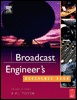
Providing detailed coverage and quick access to key technologies, standards and practices, this authoritative reference work covers the broad landscape of television technology in one handy source.
 TABLE OF CONTENTS
 E. P. J. Tozer
Zetrox Broadcast Communications
Timecode is an essential component of the professional broadcast system, providing a reference and synchronising signal for audio and video programme material.
Timecode indicates time to video frame accuracy with a 24-hour range as HH:MM:SS:FF, typically displayed as either +/- 12 hours or 0 24 hours, i.e. 00:00:00:00 to 23:59:59:24(29) or -12:00:00:00 to +11:59:58:24(29).
Timecode which counts 0 to 24 frames is variously referred to as EBU (European Broadcast Union), 25 frame or PAL timecode, and is used with 25 EPS (frames per second) video. Timecode which counts 0 to 29 EPS comes in two varieties, 'Drop Frame' (DF) and 'Non-Drop Frame' (NDF) timecode. Drop frame timecode is in most common use today with the NTSC 29.97 frame rate video. NDF timecode would normally be used with (uncommon) 30 FPS 'non-drop frame' video. Both DF and NDF timecode are referred to as SMPTE (Society of Motion Picture and Television Engineers) timecode.
NDF timecode counts 0 to 29 frames. If this count is used with 29.97 Hz (30 1000/1001 Hz) video there will be approximately a 0.1% count error of timecode time with respect to real time; this is approximately equivalent to timecode running 3.6 seconds per hour too slow. To correct this discrepancy DF time-code misses the count of the first two frames of the first second of each minute, so 01:57:59:29 is followed by DF time value 01:58:00:02; unfortunately if this is...