Class A ERP Implementation: Integrating Lean and Six Sigma
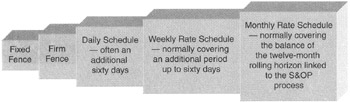
Supply chain management has received a lot of attention in books and seminars in the last few years with good reason. Suppliers are the lifeline of most businesses. Whenever their performance is anything but synchronized with the procurement schedule, unnecessary costs are incurred. Many poorly managed businesses run their supply chain management through expediting and priority freight. Class A businesses do not work that way. Good supply chain management means that the suppliers of greatest importance share information daily, sometimes hourly. Whenever changes are made to the schedule, suppliers are involved in the decisions, particularly when lead times or rules of engagement are violated. Figure 10.1 was also used in Chapter 7 on master scheduling. This illustration will become more and more meaningful as the discussion on the supply chain continues.
In a Class A ERP organization, there should be little schedule movement within the fixed fence. Any changes to the schedule within this short time frame need to be cleared with the supplier. Remember that this time frame does not have to be very long. The statistics in Table 10.1 suggest average time frames for the fixed fence in an unscientific survey of high-performance clients I have worked with.
| Time Frame | Percentage | Cumulative Percentage |
|---|---|---|
| One day | 35 percent | |
| Two days | 25 percent | 60 percent within two days |
| Three days | 5 percent | 65 percent within three days |
| Five days |