Class A ERP Implementation: Integrating Lean and Six Sigma
Not very long ago, manufacturing departments were always arranged by function. Welders were located together, lathes were all in the same department, milling machines were set side by side, etc. It just seemed to make sense. This was prior to the acute awareness of waste developed from lean thinking. In today's high-performance organizations, there is a much more educated view of material flow.
At The Raymond Corporation in the 1970s, we had what we considered to be good process flow. I remember giving tours through the plant and explaining that material started in the steel shop and progressed to shipping in a logical layout. The plant looked very much like Figure 11.4.
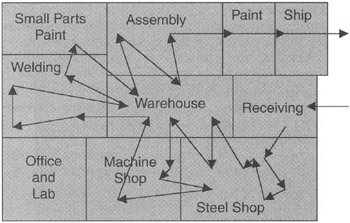
While the factory flow in Figure 11.4 may seem like a logical path for process flow (and during tours it was even described in that way), in reality it was not. It took an exercise of tracking actual material flow through the process to understand the opportunity. On a factory layout drawing, we tracked the flow and marked the path on the paper. What we found was something like Figure 11.5. Material actually flowed around and around the shop. If we dropped a string on the path, it probably would have taken miles. We did not measure it. This was an eye-opening experience. We immediately went about solving this cost-added opportunity.
At first there was a bit of concern about the...