Class A ERP Implementation: Integrating Lean and Six Sigma
Some readers will see the title of this chapter in the table of contents, at first glance, and will start to read the book here. In some ways, I can understand. Metrics are the drivers and source of needed information. High-performance companies do not run without them, and poorly managed and performing companies often have the wrong metrics in place or none at all. This makes performance measurements a necessary part of the feedback loop in businesses that are serious about improvement. In many ways, metrics are the keys to the palace. Class A ERP is built around metrics and the management system to keep the metrics changing and fresh.
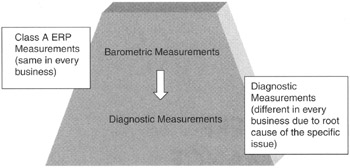
There are two types of metrics in a Class A process (Figure 16. l). Many years ago at The Raymond Corporation, one of the first and best master schedulers I have worked with determined that the normal Class A metrics that are always appropriate in every business are "barometric" measures they tell you if a storm front is coming. These metrics do not necessarily tell you what the cause is; they only point you in the right direction. The barometric measures should be maintained even when the performance level is sustained for many months. The reason these metrics continue to exist is for auto-audit purposes understanding things are still in control from that perspective.
There is another level of metrics required in every business called "diagnostic" measures.