Class A ERP Implementation: Integrating Lean and Six Sigma
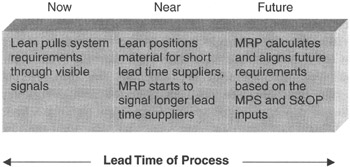
Material requirements planning (MRP) is a planning tool. Firm requirements are not the same as planned requirements. Whereas kanban and pull systems are designed and efficient to take care of firm requirements, MRP is a tool that still has its place in managing the planned requirements. At some point, the planned orders become firm, and that is when MRP adds little value and lean steps up to the plate to keep schedule adherence disciplines and keep waste out of the process at the same time. Once the orders are firm and the MPS has authorized the start of work on a requirement, there is no need for MRP (Figure 11.3).
In one of my earliest examples of this, a capital goods manufacturer had customer-order steel requirements every day that had to be welded to make the main infrastructure of the product. Both the height and width of the final product could vary depending on customer-specific application, so there was no reason to build this product early. To do so would mean forecasting requirements and stockpiling an infinite number of possibilities. It was a no-brainer to use lean techniques. This was even before lean had made the circuit as the latest thinking. Going even beyond this, the other smaller components of the process that welded to these larger steel members would normally have been planned by MRP and pulled from stock as needed. The process was instead migrated to...