Fundamentals of Solid State Engineering, 2nd Edition
In Chapter 5, we built simple mathematical models to describe the vibrations of atoms, first in a one-dimensional system and then extended to a three-dimensional harmonic crystal. These models, in the quantum description, led us to introduce a quasi-particle called the phonon, with an associated momentum and energy spectrum. Many of the phenomena measured in crystals can be traced back to phonons.
In this Chapter, we will employ the results of the phonon formalism used in Chapter 5 to interpret the thermal properties of crystals, in particular their heat capacity, thermal expansion and thermal conductivity.
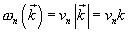
The Debye model was developed in the early stages of the quantum theory of lattice vibration in an effort to describe the observed heat capacity of solids (section 6.3). The model relies on a simplification of the phonon dispersion relation (see for example Eq. (5.22), Fig. 5.5 or Fig. 5.9). In the Debye model, all the phonon branches are replaced with three acoustic branches, one longitudinal ( l) and two transversal ( t), with corresponding phonon spectra:
| (6.1) | |
where n (= l or t) is an index; k is the norm or length of the wavevector
, v l and v t are the longitudinal and transversal sound velocities, respectively. This model corresponds to a linearization of the phonon spectrum as shown in Fig. 6.1. But this linearization implies that the phonon frequencies depend solely on...