Fundamentals of Solid State Engineering, 2nd Edition

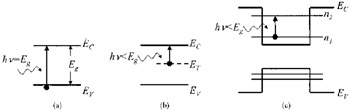
In the previous Chapter, the basic concepts of photodetectors were outlined. Furthermore, thermal detectors and the bolometer, specifically, were described in detail. In photon detectors, incident photons interact with the electrons in the material and change the electronic charge distribution. This perturbation of the charge distribution generates a current or a voltage that can be measured by an electrical circuit. Because the photon-electron interaction is "instantaneous", the response speed of photon detectors is much higher than that of thermal detectors. Indeed, by contrast to thermal detectors, quantum or photon detectors respond to incident radiation through the excitation of electrons into a non-equilibrium state. The mechanisms of electron excitation are shown in Fig. 20.1.
Semiconductor photon detectors may rely on interband electron excitation (Fig. 20.1(a)) (intrinsic detectors), on impurity-band transition (Fig. 20.1(b)) (extrinsic detectors) or intersubband transitions in a quantum well (Fig. 20.1(c)) (quantum well intersubband photodetectors). In intrinsic semiconductors, an electron in the valence band absorbs the energy of an incident photon and is excited into the conduction band. Extrinsic semiconductor detection occurs when an electron from a trap level inside the bandgap absorbs the energy of an incident photon and is excited into the conduction band. Intersubband detectors feature an electron in a quantum-confined state that can be excited into a higher energy state or continuum level. In the following sub-sections, the two main...