Fundamentals of Solid State Engineering, 2nd Edition
18.2. Types of Lasers

18.2. Types of Lasers

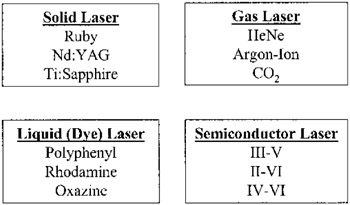
Over the past forty years, scientists have investigated and developed many types of lasers. These lasers fall into several broad categories, as categorized in Fig. 18.1.


Figure 18.1: Different types of lasers with several examples for each type.

Solid lasers are typically crystals that are doped with specific impurities, which introduce energy levels in the band structure of the crystal. These energy levels determine the energy (or wavelength) of the light emitted by the laser. Solid lasers need to be optically pumped in order to emit light, i.e. the energy needed to make the laser emit light is provided by illuminating the crystal with intense light. This is done typically with an incoherent white flash lamp, though many commercial lasers are now incorporating semiconductor lasers tuned to the optimum absorption frequency for higher efficiency. The power conversion efficiency of a laser is the ratio of the output power it emits to the total power used. Typical power conversion efficiency for a solid laser ranges from 0.1~5 %.

Gas lasers are very similar to solid lasers. However, instead of impurities, the energy of the light emitted depends on the gas mixture used. The gas mixture is excited by an electrical discharge. Due to a low-absorption efficiency, high voltage discharge (typically 2 4 kV) is used to transfer energy to the gas mixture. The mixture normally consists of an inert gas that absorbs the discharge energy and transfers it to an active gas atom, whose allowed energy levels (as...

UNLIMITED FREE
ACCESS
TO THE WORLD'S BEST IDEAS

SUBMIT
Already a GlobalSpec user? Log in.

This is embarrasing...

An error occurred while processing the form. Please try again in a few minutes.

Customize Your GlobalSpec Experience

Category: Nitrogen Lasers
Finish!
Privacy Policy

This is embarrasing...

An error occurred while processing the form. Please try again in a few minutes.