Fundamentals of Solid State Engineering, 2nd Edition
In Chapter 4, we discussed the quantum mechanical states of electrons in a periodic crystal potential and the resulting formation of energy bands. We also introduced the concept of effective mass, that of holes, and the Fermi energy which provides an easy way to differentiate a semiconductor from a metal.
In semiconductor devices, most of the properties of interest have their origins in the electrons in the conduction band and the holes in the valence band. Two major functions are important in understanding the behavior of these electrons and holes: the density of states and the Fermi-Dirac distribution function, both of which have been discussed in Chapter 3 and Chapter 4. In this Chapter, we will establish the basic relations and formalism for the distribution of electrons in the conduction band and holes in the valence band at thermal equilibrium. We will also introduce the notion of doping and extrinsic semiconductors, in contrast to pure or intrinsic semiconductors.
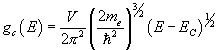
In Chapter 4, we calculated the density of states of electrons of the conduction band in a three-dimensional semiconductor to be:
| (7.1) | |
where m e is the electron effective mass in the conduction band, E C is the bottom of the conduction band and V is the volume of the crystal considered. The subscript "c" in g c indicates that we are considering the conduction band. This expression was calculated for a single band minimum and is valid for direct-gap semiconductors, such...