B.1 Some Useful Probability Distributions
Consider that h is a complex Gaussian variable, i.e. a circularly complex variable with zero-mean and variance ? 2. This means that both the real and imaginary parts of h are zero-mean Gaussian variables of variance ? 2. In this case, s ? h follows a Rayleigh distribution
| (B.1) | 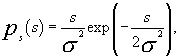
|
with the following properties:
| (B.2) | 
|
| (B.3) | 
|
The CDF of s is given by
| (B.4) | 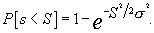
|
The random variable y ? h 2 = s 2 follows a X 2 distribution (with two degrees of freedom)
| (B.5) | 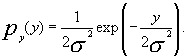
|
Note that for small ?, we have that P[ y < ?] ? ?.
Let us now consider n i.i.d. zero-mean complex Gaussian variables h 1 , ,h n with variance ? 2. Defining  , the moment generating function of u is given by
| (B.6) | 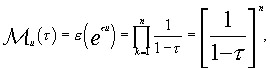
|
and the distribution of u reads as
| (B.7) | 
|
This distribution is known as the ? 2 distribution with 2 n degrees of freedom (the case n = 1 reduces to (B.5)). The corresponding CDF is given by
| (B.8) | 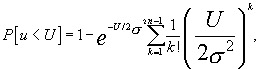
|
| (B.9) | 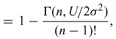
|
| (B.10) | 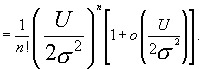
|
Finally, let us now analyze the case when h 1 , ,h n are non-zero mean. Assume that the real and imaginary parts of h k are Gaussian variables of mean ? k and variance ? 2. In this situation, 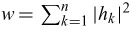 follows...


 TABLE OF CONTENTS