The Finite Element Method for Solid and Structural Mechanics, Sixth Edition

4.5: Isotropic Plasticity Models

4.5 Isotropic Plasticity Models

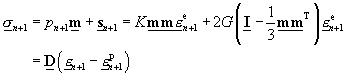
We consider here some simple cases for isotropic plasticity-type models in which both a yield function and a flow rule are used. For an isotropic material linear elastic response may be expressed by moduli defined with two parameters. Here we shall assume these to be the bulk and shear moduli, as used previously in the viscoelastic section (Sec. 4.2). Accordingly, the stress at any discrete time t n+ 1 is computed from elastic strains in matrix form as

(4.93)

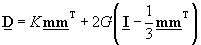
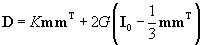
where the elastic modulus matrix for an isotropic material is given in the simple form

(4.94)

and I is the 9 9 identity matrix and m is the nine-component matrix


Using Eqs (4.42) and (4.43) immediately reduces the above to

(4.95)

The above relation yields the stress at the current time provided we know the current total strain and the current plastic strain values. The total strain is available from the finite element equations using the current value of nodal displacements, and the plastic strain is assumed to be computed with use of one of the algorithms given above. In the discussion to follow we consider relations for various classical yield surfaces.

4.5.1 Isotropic Yield Surfaces

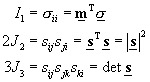
The general procedures outlined in the previous section allow determination of the tangent matrices for almost any yield surface applicable in practice. For an isotropic material all functions can be represented in terms of the three stress invariants: [*]

(4.96)

where we can observe that definition of...

UNLIMITED FREE
ACCESS
TO THE WORLD'S BEST IDEAS

SUBMIT
Already a GlobalSpec user? Log in.

This is embarrasing...

An error occurred while processing the form. Please try again in a few minutes.

Customize Your GlobalSpec Experience

Category: Refractory Services
Finish!
Privacy Policy

This is embarrasing...

An error occurred while processing the form. Please try again in a few minutes.