The Finite Element Method for Solid and Structural Mechanics, Sixth Edition

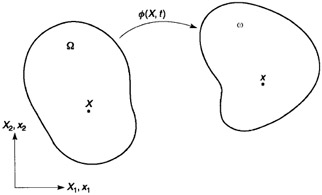
In all our previous discussion we have assumed that deformations remained small so that linear relations could be used to represent the strain in a body. We now admit the possibility that deformations can become large during a loading process. In such cases it is necessary to distinguish between the reference configuration where initial shape of the body or bodies to be analysed is known and the current or deformed configuration after loading is applied. Figure 5.1 shows the two configurations and the coordinate frames which will be used to describe each one. We note that the deformed configuration of the body is unknown at the start of an analysis and, therefore, must be determined as part of the solution process - a process that is inherently non-linear. The relationships describing the finite deformation behaviour of solids involve equations related to both the reference and the deformed configurations. We shall generally find that such relations are most easily expressed using indicial notation (e.g. see Chapter 1, Sec. 1.2.1 or Appendix B of reference 1); however, after these indicial forms are developed we shall again return to a matrix form to construct the finite element approximations.
The chapter starts by describing the basic kinematic relations used in finite deformation solid mechanics. This is followed by a summary of different stress and traction measures related to the reference and deformed configurations, a statement of boundary and...