The Finite Element Method for Solid and Structural Mechanics, Sixth Edition

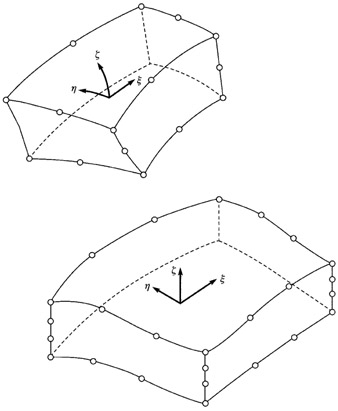
In the analysis of solids the use of isoparametric, curved, two- and three-dimensional elements is particularly effective, as illustrated in Chapters 2 and 4 and presented in reference 1. It seems obvious that use of such elements in the analysis of curved shells could be made directly simply by reducing their dimension in the thickness direction as shown in Fig. 15.1. Indeed, in an axisymmetric situation such an application is illustrated in the example of Fig. 9.25 of reference 1. With a straightforward use of the three-dimensional concept, however, certain difficulties will be encountered.
In the first place the retention of 3 displacement degrees of freedom at each node leads to large stiffness coefficients from strains in the shell thickness direction. This presents numerical problems and may lead to ill-conditioned equations when the shell thickness becomes small compared with other dimensions of the element.
The second factor is that of economy. The use of several nodes across the shell thickness ignores the well-known fact that even for thick shells the 'normals' to the mid-surface remain practically straight after deformation. Thus an unnecessarily high number of degrees of freedom has to be carried, involving penalties of computer time.
In this chapter we present specialized formulations which overcome both of these difficulties. The constraint of straight 'normals' is introduced to improve economy and the strain energy corresponding to the stress perpendicular to the mid-surface is ignored to...