The Finite Element Method for Solid and Structural Mechanics, Sixth Edition

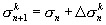
We have emphasized that with the use of iterative procedures within a particular increment of loading, it is important always to compute the stresses as
| (4.73) | |
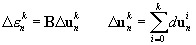
corresponding to the total change in displacement parameters
and hence the total strain change
| (4.74) | |
which has accumulated in all previous iterations within the step. This point is of considerable importance as constitutive models with path dependence (viz. plasticity-type models) have different responses for loading and unloading. If a decision on loading/unloading is based on the increment
erroneous results will be obtained. Such decisions must always be performed with respect to the total increment
.
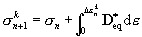
In terms of the elasto-plastic modulus matrix given by Eq. (4.72) this means that the stresses have to be integrated as
| (4.75) | |
incorporating into
the dependence on variables in a manner corresponding to a linear increase of
(or
). Here, of course, all other rate equations have to be suitably integrated, though this generally presents little additional difficulty.
Various procedures for integration of Eq. (4.75) have been adopted and can be classified into explicit and implicit categories.
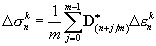
In explicit procedures either a direct integration process is used or some form of the Runge-Kutta process is adopted.44 In the former the known increment
is subdivided into m intervals and the integral of Eq. (4.75) is replaced by direct summation, writing
| (4.76) | |
where
denotes the tangent matrix computed for stresses and hardening parameters updated from...