The Finite Element Method for Solid and Structural Mechanics, Sixth Edition

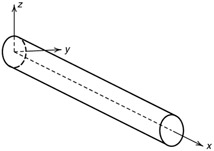
In the previous chapters we considered the domain to be a continuum, a rigid multi-body system or a set of discrete elements. In the study of continuum problems we developed finite element approximations based on approximation of the displacement, stress and strain fields at each point in the domain. While such approximation is general there are instances when it is difficult to obtain viable solutions economically. Many such situations arise when one or two dimensions of the domain are small compared to the others. For example, when two dimensions are small we have a very slender cross-section which is translated along a one-dimensional axis as shown in Fig. 10.1. Such a form is herein called a rod and consists of a member which carries axial, shear, moment and torsion force resultants. When one dimension is small compared to the other two we have either a plate theory for initially flat surfaces or a shell theory for general curved surfaces. In this chapter we consider the behaviour of rods. Plate and shell problems will be considered in subsequent chapters.
Bending of rods is generally associated with a beam theory such as the classical Euler-Bernoulli theory studied in introductory strength of materials. 1 3 If one attempts to model a rod with a standard three-dimensional finite element model there are two aspects which give difficulty. One is purely numerical and associated with large round-off errors when attempting to solve the simultaneous equations.4 The other...