The Finite Element Method for Solid and Structural Mechanics, Sixth Edition

4.8: Basic Formulation of Creep Problems

4.8 Basic Formulation of Creep Problems

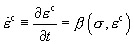
The phenomenon of 'creep' is manifested by a time-dependent deformation under a constant stress. Indeed the viscoelastic behaviour described in Sec. 4.2 is a particular model for linear creep. Here we shall deal with some non-linear models. Thus, in addition to an instantaneous strain, the material develops creep strains, ? c, which generally increase with duration of loading. The constitutive law of creep will usually be of a form in which the rate of creep strain is defined as some function of stresses and the total creep strains ( ? c), that is,

(4.155)

If we consider the instantaneous strains are elastic ( ? e), the total strain can be written again in an additive form as

(4.156)

with

(4.157)

where we neglect any initial (thermal) strains or initial (residual) stresses. A special case of this form was considered for linear viscoelasticity in Sec. 4.2. Here we consider a more general non-linear approach commonly used in modelling behaviour of metals at elevated temperatures and in modelling creep in cementitious materials.

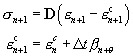
We can again use any of the time integration schemes considered above and approximate the constitutive equations in a form similar to that used in plasticity as

(4.158)

where ? n+? is calculated as


On eliminating ? ? c we have simply a non-linear equation

(4.159)

The system of equations can be solved iteratively using, say, the Newton procedure. Starting from some initial guess, say ? n +1

UNLIMITED FREE
ACCESS
TO THE WORLD'S BEST IDEAS

SUBMIT
Already a GlobalSpec user? Log in.

This is embarrasing...

An error occurred while processing the form. Please try again in a few minutes.

Customize Your GlobalSpec Experience

Category: Mechanical Testing Services
Finish!
Privacy Policy

This is embarrasing...

An error occurred while processing the form. Please try again in a few minutes.