The Finite Element Method for Solid and Structural Mechanics, Sixth Edition

An isoparametric formulation may be used for any problem in which the approximations are C 0 continuous. In an isoparametric formulation a parent element is defined in terms of a set of natural coordinates. The shape functions are constructed on a parent element and used to compute the coordinates within each element using
| (A.1) | |
where N a denotes the shape function, ? are a set of natural coordinates and
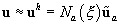
are nodal coordinates. A dependent variable u is then approximated as
| (A.2) | |
The construction of shape functions requires the selection of an appropriate set of natural coordinates. Here we first summarize the form for quadrilateral and brick elements in two and three dimensions, respectively. We then consider triangular and tetrahedral elements.
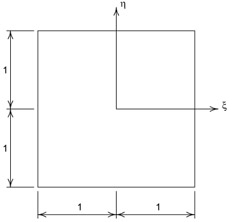
The natural coordinates for a quadrilateral element are given by
as shown in Fig. A.1.
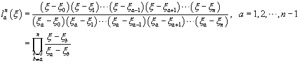
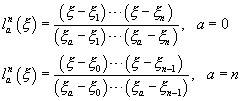
The simplest group of elements construct the shape functions from products of one dimensional Lagrangian interpolation functions given by
and
which gives a unit value at ? a and passes through zero at n points specified by the points ? k, k = 0, 2, , n. Using this form of interpolation we can construct the Lagrangian family of elements expressed as products of the one-dimensional functions given by
| (A.3) | |
where m and n may be different orders in the natural coordinate directions. The simplest element uses linear interpolation...