4.9.1 General Remarks
The purely plastic behaviour of solids postulated in Sec. 4.3 is probably a fiction as the maximum stress that can be carried is invariably associated with the rate at which this is applied. A purely elasto-plastic behaviour in a uniaxial loading is described in a model of Fig. 4.15(a) in which the plastic strain rate is zero for stresses below yield, that is,
and  is indeterminate when ? - ? y = 0.
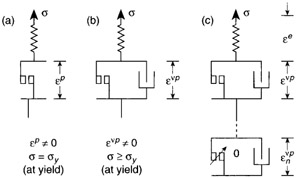 Figure 4.15: (a) Elasto-plastic; (b) elasto-viscoplastic; (c) series of elasto-viscoplastic models.
 An elasto-viscoplastic material, on the other hand, can be modelled as shown in Fig. 4.15(b), where a dashpot is placed in parallel with the plastic element. Now stresses can exceed ? y for strain rates other than zero.
The viscoplastic (or creep) strain rate is now given by a general expression
| (4.168) | 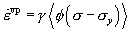
|
where the arbitrary function ? is such that
| (4.169) | 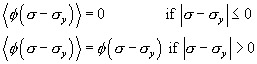
|
The model suggested is, in fact, of a creep-type category described in the previous sections and often is more realistic than that of classical plasticity.
A viscoplastic model for a general stress state is given here and follows precisely the arguments of the plasticity section. In a three-dimensional context ? becomes a function of the yield condition F( ?, ? , ?) defined in Eq. (4.44). If this is less than zero, no 'plastic' flow will occur. To include the viscoplastic behaviour we modify Eq. (4.44) as


 TABLE OF CONTENTS