International Accounting Standards: From UK Standards to IAS: An Accelerated Route to Understanding the Key Principles
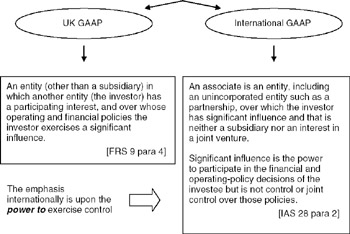
An associate represents an investment over which significant influence can be exercised, and have been accounted for using a method known as equity accounting for many years. The underlying methodology of this approach is consistent between UK GAAP and international accounting practice, but there are some differences in the detail, and marked disparities in the way the end result is presented within the financial statements.

Under UK GAAP equity accounting is only required in the context of group financial statements, whereas international GAAP requires a broader application which include economic entity financial statements. The latter represent the financial statements of an investor that does not have subsidiaries, and consequently are not required to produce consolidated financial statements.
Economic entity financial statements should not be confused with separate financial statements. It would be easy to believe that the latter simply represented any financial statements other than consolidated financial statements, but the reality is that the classification is narrower, and effectively restricted to the following circumstances:
An entity required to produce consolidated financial state ments additionally produces individual financial statements for the parent company alone. These separate financial statements might be produced voluntarily or be required under local legislation.
Investors specifically exempted from the requirement to consolidate or equity account may produce separate financial statements.
Do not get too concerned about the pedantics of this section, but do remember that unlike UK GAAP equity accounting may be required beyond consolidated financial...