International Accounting Standards: From UK Standards to IAS: An Accelerated Route to Understanding the Key Principles

With the obvious exception of a different label, inventory replacing stock, the accounting treatment for this key asset is fundamentally identical. Hence stock/inventory is valued at the lower of cost and net realizable value.
Historically there was a divergence in treatment when considering the cost-flow strategies allowed under UK and international accounting rules. UK GAAP has always prohibited the use of LIFO (Last-In Last-Out), but a similar ban was only introduced to international GAAP in 2004. It is worthy of note that LIFO remains an acknowledged method in the US further demonstrating the difficulties which remain in producing a global GAAP.
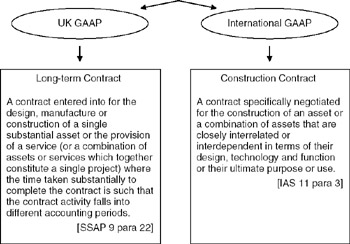
UK long-term contracts appear more at odds with their international counterpart, construction contracts, for which there is a separate accounting standard. Closer examination reveals that the differences are again minor as will be proved by the following comparison.

Internationally less emphasis is placed upon the concept of long term and hence it is possible that a company adopting IAS 11 will apply a percentage of completion methodology to the recognition of a short contract. In the UK it is more likely that a completed contract methodology would be used.
| Note | Remember that the term completed contract methodology refers to circumstances when no profits are recognized during the life of a contract, but are taken in one hit upon completion. This is a very prudent approach but results in a lack of matching of profits to activity for a longer contract. |
A...