Design of High-Speed Communication Circuits
3. Low Noise Amplifiers

3. Low Noise Amplifiers

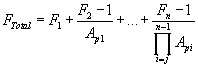
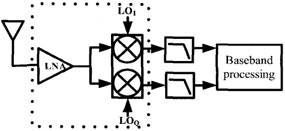
A low noise amplifier (LNA) is the first active stage of an RF receiver (Fig. 8). The foremost task of an LNA is to amplify the RF signal and suppress noise contributions from subsequent stages. For an n-stage cascade, the overall noise factor is given by the Friis equation [18]:

(2)

Figure 8: A simple RF receiver

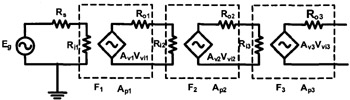
where F i and A pi are the noise factor and available power gain of the ith-stage, respectively (Fig. 9). Thus, high gain ( A pl) and low noise factor ( F j) of the first stage (LNA) of an RF receiver are critical for an overall receiver low noise factor ( F Rx). Apart from high gain and low noise factor, an LNA needs to present a 50 ? termination at its input to the transmission line from the antenna or the pre-select filter preceding the LNA so the filtering characteristics such as insertion loss and pass band ripple are ensured.


Figure 9: An n-stage cascaded system

In addition to gain, noise figure, and input matching, other performance parameters critical to an LNA include stability, power consumption, robustness against process, voltage, and temperature (PVT) variations, and linearity, which is typically characterized by the second- or third-order intermodulation product [19].

The two most widely adopted LNA topologies are inductively degenerated common-source and common-gate amplifiers. While the common-source topology provides higher transconductance and superior noise figure (NF), its common-gate counterpart offers...

UNLIMITED FREE
ACCESS
TO THE WORLD'S BEST IDEAS

SUBMIT
Already a GlobalSpec user? Log in.

This is embarrasing...

An error occurred while processing the form. Please try again in a few minutes.

Customize Your GlobalSpec Experience

Category: RF MOSFET Transistors
Finish!
Privacy Policy

This is embarrasing...

An error occurred while processing the form. Please try again in a few minutes.