Design of High-Speed Communication Circuits
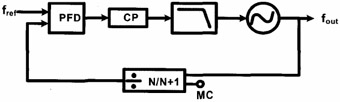
The LO port of the mixer is driven by a phase-locked loop (PLL) frequency synthesizer. Shown in Fig. 33, a typical PLL consists of a phase detector, a charge-pump, a loop filter, a voltage-controlled oscillator (VCO), and a frequency divider connected in a loop so its output frequency can be locked and will not drift in the presence of device noise. One of the most important blocks in the PLL is the voltage-controlled oscillator.
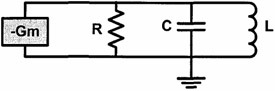
Oscillators can be classified into two categories: relaxation oscillators and harmonic oscillators. Relaxation oscillators usually have high harmonic content and poor phase noise performance while harmonic oscillators, which typically use LC resonators or crystals, have high spectral purity and offer good noise performance. The majority of the oscillators used in wireless applications today are resonator-based oscillators. Shown in Fig. 34, the cross-coupled LC VCO is arguably the most common VCO being designed in the world. The VCO can be modeled as shown in Fig. 35. The inductor L, varactors Cvar, and parasitics of the MOSFETs form a resonant network that defines the frequency of oscillation:
| (16) | |
The parallel resistance R models the loss due to the metal resistance in the inductor and the varactor. The NMOS and PMOS cross-coupled pairs form a small-signal negative resistance generator to cancel this loss resistance so that oscillation can be sustained. This condition determines the...