1.1 Introduction
Vectors and matrices are used extensively throughout this text. Both are essential as one cannot derive and analyze laws of physics and physical measurements without vectors and one cannot process these measurements in a digital computer without matrices. Further, each has powerful features that when combined can result in considerable derivation simplifications. We shall highlight the main similarities and the subtle differences between them.
In this context we will be concerned with Euclidean vector spaces for which the inner product is defined. In n-dimensional Euclidean vector spaces it is possible to construct a set of n orthogonal unit vectors r 1, r 2, , r n. As such, an arbitrary vector v in this space is represented by
where ? 1, ? 2, , ? n are the scalar coordinates of v.
In the special case of three dimensional vector space, the unit vectors r 1, r 2, r 3 can be graphically represented by a set of three orthogonal axes. Hence, ? 1, ? 2, ? 3 (the coordinates of the 3-dimensional vector v) are the projections of v along { r 1 , r 2 , r 3}.
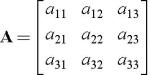
A matrix on the other hand, is an array of n rows and m columns, of n m numbers [1,2]. For example, a 3 3 matrix A is represented by
The transpose of...


 TABLE OF CONTENTS