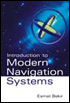
Introduction to Modern Navigation Systems
The history of navigation is intertwined with Earth. Not only because navigation is associated with the Earth's shape (spherity, landmarks), but also because it is influenced by the Earth's dynamics (gravity, rotation). People navigating the Earth from the beginning of mankind found many ways and forms though none as sophisticated as our modern means of navigation which entail such techniques as stellar, radio, GPS and inertial navigation. Our attention is entirely focused on the latter: inertial navigation.
Like all methods, inertial navigation has its advantages and shortcomings. Inconsistent accuracy resulting from its time varying errors is one of its greatest disadvantages. Nonetheless, what makes it unique and attractive is its self-reliance: its function is independent on outside sources. Short of power failure or malfunction of one of its sensors, this system can work indefinitely. At its core are a set of accelerometers, a set of gyros and a computer. The computer, by means of the gyros, tracks the craft's attitude, as in general it does not remain straight and level. The computer also integrates the accelerometer outputs to compute the velocity and once more to compute the position.
But this is a bit oversimplified. First, the accelerometers operate in a Newtonian Gravitational field and as such their measurements of the craft accelerations are biased with the Earth's gravity. Therefore, the sensor readings must be corrected for the gravity bias to yield meaningful results. Second, the gyros are also inertial sensors that measure the Earth's rotation...