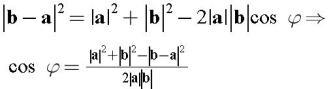
Figure A.1 depicts two coplanar vectors a and b coinciding at point o and in their co-plane lies the triangle oab. It is desired to show how the cosine of the (physical) angle between a and b can described by their vector dot product. The cosine law implies that
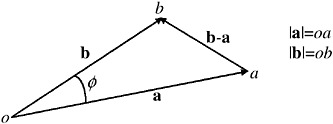 Figure A.1
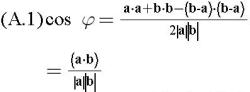
 Substituting for the lengths in terms of the respective dot products we get
where ( a b) is the vector dot product of a and b.
Now we explore the cross product property of a and b. Suppose that we have a three dimensional space defined by the orthonormal vectors ( e 1, e 2, e 3) and in which the two unit vectors a and b lie in the plane of the vectors ( e 1, e 2). With no loss of generality we shall assume that a is along e 1.
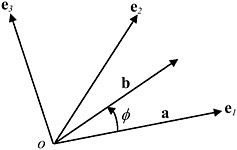 Figure A.2
 In this space the vectors a and b are represented by
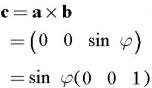
From Eq. (1.11), c, the cross product of a and b is given by
It can be seen that c is orthogonal to a and b, either by verifying that the inner product of c with both a and b is zero, or by observing that c is along e 3 which is orthogonal to the plane of the vectors
Copyright World Scientific Publishing Co. Pte. Ltd. 2007 under license agreement with Books24x7


 TABLE OF CONTENTS