Introduction to Modern Navigation Systems
Today polar navigation is a reality and no longer an adventure or an exploratory pursuit. Polar routes have been established and more airlines are navigating these routes [1]. Here we address some of the mathematical challenges associated with polar navigation and provide simple solutions.
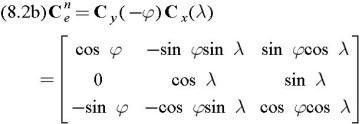
The DCM from the Earth to the Nav-frame, in Eq. (4.14), is given by
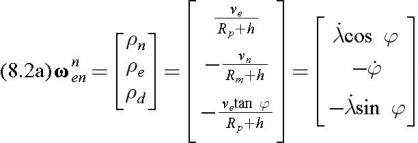
where its parameters, given by Eqs. (4.6) and (4.11), are
With this formulation, a potential problem will arise if the craft navigates close to the Earth's poles, when the latitude angle,
, approaches 90 and hence tan
will be infinite.
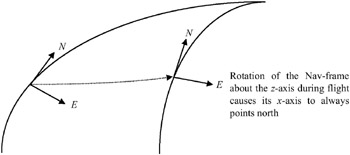
Aside from the mathematical issues, let us see how this affects an actual flight path. We know that the longitudinal lines are not parallel lines and that all meet at the north and south poles. At any point in the navigation path, the vertical rotation rate of the craft, ? d , in Eq. (8.2), prescribes the amount of rotation that aligns the x and y axes of the Nav-frame to the north and east directions, respectively (see Fig. 8.1). Near the poles, the rate of change of the longitudinal angle increases rapidly, and consequently the Nav-frame must also rotate rapidly about the z-axis to keep itself aligned to the north direction.
The wander azimuth was the approach to circumvent the polar navigation problem. The idea is to force ? d =0...