Introduction to Modern Navigation Systems

3.7: Conversion between Forms

3.7 Conversion between Forms

From the above we have four forms for expressing coordinate transformations: the DCM, the Euler angles, the rotation vector and the quaternion. Next we discuss and summarize the conversion between the different forms. Due to the close relation between the quaternion and the rotation vector, conversion to/from the rotation vector is not addressed. If needed, conversion to/or from the quaternion will be carried and then followed by using Eq. (3.17) or its inverse.

3.7.1 Conversion between DCM and Euler

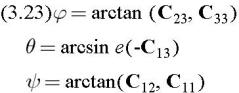
Given the Euler angles, their sines and cosines can be computed and substituted in Eq. (3.5) to give the DCM. Conversely, when the DCM is known then Eq. (3.5) gives


where C ij is the ( i th row, j th column) element of the matrix C.

3.7.2 Conversion between DCM and Quaternion

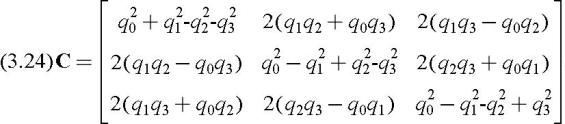
Given the quaternion, its elements can be substituted in Eq. (3.15) to generate the DCM. Expanding yields


Now we compute Q when C is given. The trace of C (the sum of its diagonal terms) is given by


In view of Eq. (3.12) the above becomes


from which


Selecting (-180,180) to be the range of a rotation angle implies that the cosine of one half of any value in this range will always be positive and hence q 0, from Eq. (3.16), will be positive.

Continuing with Eq. (3.15) it can be seen that


from which


As mentioned before, to convert a DCM to a rotation...

UNLIMITED FREE
ACCESS
TO THE WORLD'S BEST IDEAS

SUBMIT
Already a GlobalSpec user? Log in.

This is embarrasing...

An error occurred while processing the form. Please try again in a few minutes.

Customize Your GlobalSpec Experience

Category: Polarimeters
Finish!
Privacy Policy

This is embarrasing...

An error occurred while processing the form. Please try again in a few minutes.