Overview
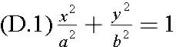
The equation of an ellipse, whose semi-major and semi-minor axes are a and b respectively, is given by
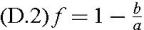
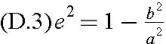
Its flatness, f, and eccentricity, e, are defined by
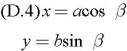
Parametrically, x and y are represented by
The tangent at an arbitrary point is given by
The angles ? and ? are depicted in Fig. D.1. If the orthogonal to the tangent intersects the x-axis at angle  , then ? =
  and Eq. (D.5) becomes
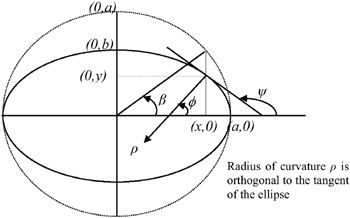 Figure D.1: Ellipse Geometry
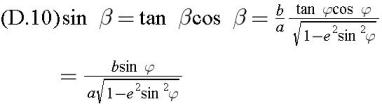
 This implies
Using Eq. (D.3), the above equation can be formed into
Taking the square root of both sides of Eq. (D.7) yields
whose inverse is given by
Equations (D.6) and (D.9) imply that
The derivative of Eq. (D.6), using Eq. (D.7), is given by
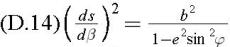
If ds is the length of an infinitesimal arc on the ellipse curve, then
We note from Eq. (D.5) that
Substituting from Eqs. (D.4) and (D.13) into Eq. (D.12) implies that
Using Eq. (D.7) to eliminate the ? term from the above equation gives
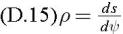
Since the radius of curvature in the ellipse plane is given by
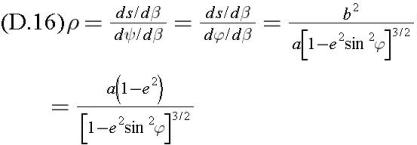
Substituting from Eqs. (D.11) and (D.14) into Eq. (D.15) yields
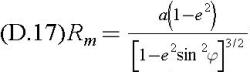
This radius of curvature is denoted by R m to distinguish it from other expressions, thus
It should be recognized that Eq. (D.17) determines the radius of curvature for all points on the ellipse curve in the plane in which it lies. We would like to step further and...


 TABLE OF CONTENTS